Home › Blog ›
Why Strong Passwords Are Your First Line of Defence — Develo
Password Security
🛡️ Why Strong Passwords Are Your First Line of Defence — Developer Guide
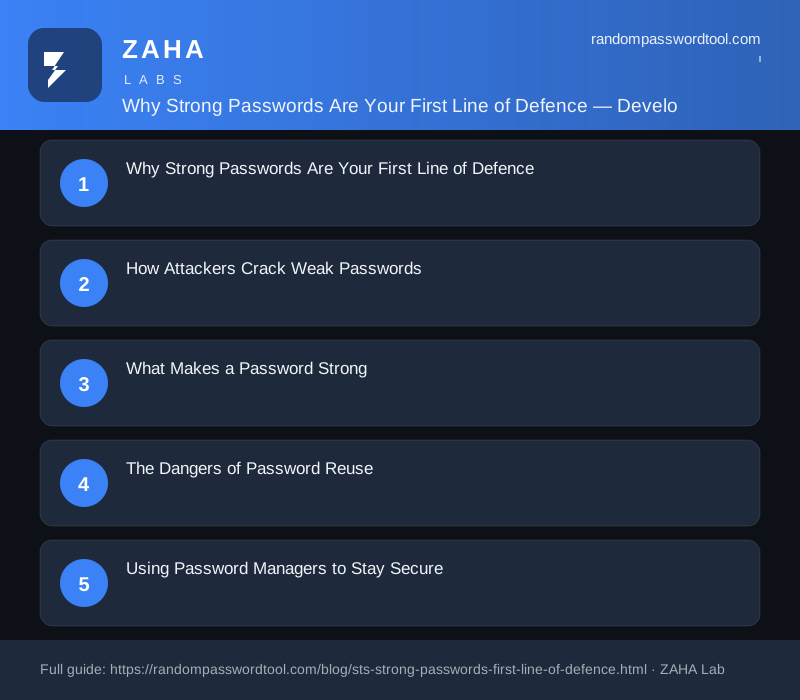
Why Strong Passwords Are Your First Line of Defence — Develo — key points at a glance
By Ateeq Y Tanoli, · 10 June 2026 · 3 min read · 0 words
Make strong password management effortless with NordPass — generate, store, and autofill strong passwords across all your devices with zero compromise on security.
Why Strong Passwords Are Your First Line of Defence
In an era where almost every part of our lives is connected to the internet, the humble password remains the single most important barrier standing between your private information and those who would misuse it. From online banking and email to social media and cloud storage, your accounts hold a remarkable amount of sensitive data. Yet despite the growing sophistication of cyber threats, weak and reused passwords continue to be one of the leading causes of security breaches worldwide. Understanding why strong passwords matter, and learning how to create and manage them effectively, is one of the simplest and most powerful steps you can take to protect yourself online.
A password is essentially a digital key. Just as you would not leave the front door of your home unlocked or hand out copies of your house key to strangers, you should not treat your passwords carelessly. The strength of that key determines how difficult it is for an attacker to break in. A weak password is the equivalent of a flimsy lock that can be picked in seconds, while a strong password acts like a reinforced vault door that takes an impractical amount of time and effort to crack.
How Attackers Crack Weak Passwords
To appreciate the value of a strong password, it helps to understand how cybercriminals attempt to break them. Attackers rarely sit and guess passwords manually. Instead, they use automated tools capable of testing millions, or even billions, of combinations every second. These methods are surprisingly effective against short or predictable passwords, and they exploit the common habits that many people fall into when choosing credentials.
Brute force attacks: Software systematically tries every possible combination of characters until it finds the correct one. Short passwords fall quickly, while longer ones become exponentially harder to crack.
Dictionary attacks: Rather than testing random characters, these attacks use lists of common words, phrases, and previously leaked passwords. If your password is a real word or a simple variation, it is highly vulnerable.
Credential stuffing: When one website suffers a data breach, attackers take the stolen usernames and passwords and try them on other sites. Because so many people reuse passwords, this technique is alarmingly successful.
Social engineering: Attackers gather personal details from social media or public records to guess passwords based on names, birthdays, pets, or favourite teams.
Each of these methods preys on convenience and predictability. The more unique, complex, and lengthy your password, the more resistant it becomes to every one of these approaches.
What Makes a Password Strong
Not all passwords are created equal. A strong password is one that is difficult for both humans and machines to guess, yet ideally still possible for you to remember or securely store. There are several key characteristics that separate a robust password from a vulnerable one, and combining them dramatically increases your security.
Length: Length is arguably the most important factor. A password of at least twelve to sixteen characters is far harder to crack than a short one, even if the short one contains complex symbols.
Complexity: Mixing uppercase letters, lowercase letters, numbers, and special symbols increases the number of possible combinations an attacker must test.
Unpredictability: Avoid common words, sequential numbers, and obvious patterns such as "123456" or "qwerty". Randomness is your friend.
Uniqueness: Every account should have its own distinct password so that a breach on one site does not compromise the others.
One increasingly popular approach is the use of passphrases. Rather than a single complex word, a passphrase strings together several random, unrelated words, such as "copper-lantern-river-thistle". These are long, difficult to crack, and surprisingly easy to remember compared to a jumble of random symbols.
The Dangers of Password Reuse
Perhaps the most common and damaging mistake people make is reusing the same password across multiple accounts. It is understandable, given how many logins the average person juggles, but the risks are severe. When you reuse a password, a single data breach can cascade into a complete compromise of your digital identity. An attacker who obtains your password from a poorly secured shopping site can suddenly access your email, which in turn can be used to reset passwords on every other service you use.
Your email account is particularly critical because it often serves as the recovery method for everything else. If a criminal gains control of it, they can lock you out of your own accounts, intercept sensitive communications, and impersonate you to friends, family, or colleagues. This is why treating each password as unique is not merely good practice but an essential safeguard against widespread damage.
Using Password Managers to Stay Secure
One of the biggest objections to strong, unique passwords is that they are impossible to remember. This is a legitimate concern, but it is also one that technology has comprehensively solved. Password managers are secure applications designed to generate, store, and autofill complex passwords for all of your accounts. You only need to remember one strong master password, and the manager handles the rest.
The benefits of using a password manager are considerable, and they remove much of the friction that leads people to make poor security choices in the first place.
They generate genuinely random, lengthy passwords that no human could guess.
They store every credential in an encrypted vault, protected by your master password.
They eliminate the temptation to reuse passwords across multiple sites.
They can alert you when a password has appeared in a known data breach.
They synchronise across your devices, making secure access convenient.
By delegating the difficult work of remembering dozens of complex passwords to a trusted tool, you free yourself to follow best practices without the mental burden.
Strengthening Passwords With Extra Layers
While a strong password is your first line of defence, it should not be your only one. Multi-factor authentication, often abbreviated as MFA or two-factor authentication, adds a crucial second barrier. Even if an attacker somehow obtains your password, they would still need a second piece of verification, such as a code from an authentication app or a fingerprint, to gain access. Enabling MFA wherever it is offered transforms a single point of failure into a far more resilient defence.
It is also wise to stay alert to phishing attempts, which try to trick you into revealing your password voluntarily. No password, however strong, can protect you if you hand it directly to a criminal. Always verify the authenticity of websites and emails before entering your credentials, and be sceptical of urgent messages demanding immediate action.
Building Better Password Habits
Ultimately, strong passwords are about cultivating good habits rather than chasing perfection. Start by updating the passwords on your most important accounts, particularly your email and financial services. Replace any reused or weak passwords with long, unique alternatives, and adopt a password manager to keep track of them. Enable multi-factor authentication, and review your accounts periodically to ensure none have been exposed in breaches.
These steps may seem small, but together they form a powerful shield against the vast majority of cyber threats. In a digital world full of risks, a strong password remains your most accessible, affordable, and effective first line of defence. Investing a little time today to secure your accounts can save you from the considerable stress, expense, and disruption of a breach tomorrow.
We use cookies to improve your experience. Learn more