Home › Blog ›
Password Generation at Scale: Patterns for IAM Provisioning
Engineering
🏗️ Password Generation at Scale: Patterns for IAM Provisioning Pipelines
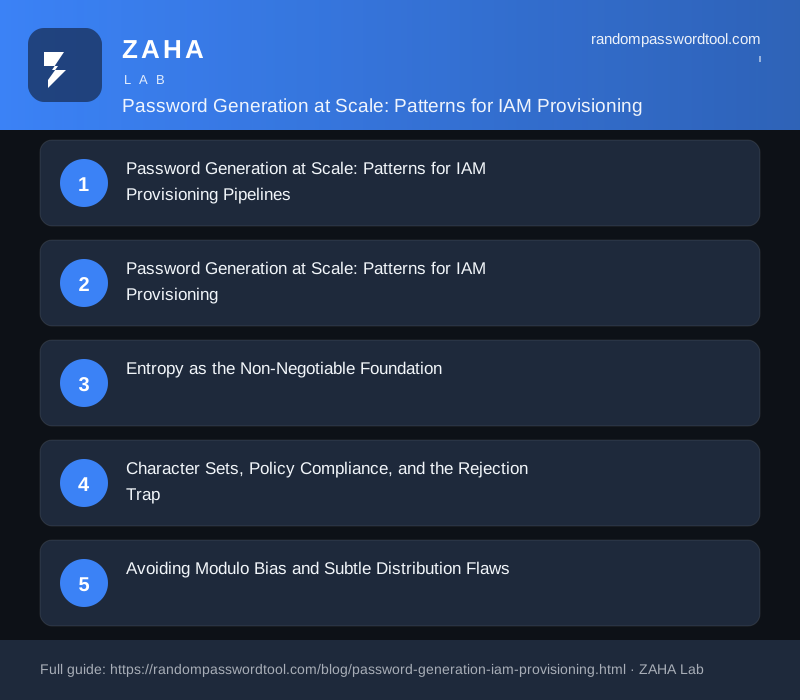
Password Generation at Scale: Patterns for IAM Provisioning — key points at a glance
By Owen Blackwood, · 25 Apr 2026 · 3 min read · 250 words
Password Generation at Scale: Patterns for IAM Provisioning Pipelines
When your Identity and Access Management system needs to provision thousands of users, password generation must be consistent, cryptographically secure, and fully automated. This guide covers architectural patterns for IAM provisioning pipelines. For teams managing credentials at scale, 1Password provides a central vault for all provisioned secrets across environments.
Batch Generation Pattern
The simplest pattern for bulk provisioning: generate all passwords upfront, import them into the IAM system, and force a change on first login.
For very large batches (10,000+ users), generate passwords on-demand rather than pre-computing all of them to avoid holding plaintext passwords in memory.
Hybrid Cloud Pattern
When provisioning spans on-prem AD and cloud IDPs (Azure AD, Okta), use a unified pipeline that generates once and maps to each target system's schema.
The Notification Pipeline
After generation, users must receive their credentials securely. Common patterns include:
Self-service portal: User clicks "claim account" and sets their own password
HR-distributed envelopes: HR delivers passwords through existing onboarding channels
SMS/email fragments: Send partial credentials through different channels
Rate Limiting and Throttling
IAM systems have rate limits. Batch imports should respect these:
AD: 50-100 users per batch with 30-second pauses
Azure AD: 500 users per bulk operation
Okta: 10 API requests per second for standard plans
Password Generation at Scale: Patterns for IAM Provisioning
When an identity and access management (IAM) platform provisions thousands of new accounts, service principals, and machine identities every day, the humble password becomes an engineering problem rather than a user inconvenience. At scale, the question is no longer "what makes a strong password?" but "how do we generate, distribute, and rotate millions of credentials without creating bottlenecks, collisions, or silent weaknesses?" The patterns that work for a single login form rarely survive contact with automated provisioning pipelines, so IAM architects need a deliberate approach grounded in entropy guarantees, predictable performance, and clean separation between generation and storage.
Entropy as the Non-Negotiable Foundation
Every credential a provisioning system emits should trace back to a cryptographically secure pseudorandom number generator (CSPRNG). Language-level conveniences like Math.random() or unseeded PRNGs are catastrophic at scale because their predictability compounds: an attacker who recovers the internal state from one leaked password can reconstruct an entire batch. The correct primitives are operating-system entropy sources surfaced through interfaces such as /dev/urandom, getrandom(), or platform abstractions like Java's SecureRandom and the Web Crypto API's crypto.getRandomValues().
Entropy targets should be expressed in bits, not character counts. A useful rule is to size each generated secret for its threat model:
Human-recoverable break-glass passwords: 80–100 bits of entropy, balanced against typeability.
Service account and API credentials: 128 bits minimum, since no human ever types them.
Long-lived root or master keys: 256 bits, treated as effectively irreplaceable.
Computing entropy correctly means accounting for the real alphabet and length, not the theoretical maximum. If a policy filter rejects certain characters after generation, the effective entropy drops, so the cleaner pattern is to generate from a known alphabet and length that already satisfy policy.
Character Sets, Policy Compliance, and the Rejection Trap
Downstream systems impose maddeningly diverse password rules: minimum lengths, required character classes, forbidden symbols, and maximum lengths that silently truncate. A naive generator produces a random string and loops until the result happens to satisfy every rule. This "generate and reject" loop is dangerous at scale because its runtime is non-deterministic and, worse, it can bias the output distribution toward whatever the filter happens to accept.
A more robust pattern is constructive generation: guarantee each required class is present by drawing one character from each mandatory set, fill the remaining length from the union alphabet, then shuffle the whole result with a cryptographically secure permutation such as Fisher–Yates seeded from the CSPRNG. This produces compliant passwords in constant time with no rejection loop, and the entropy is computable in advance. Maintaining a per-target policy descriptor—alphabet, min/max length, required classes—lets the provisioning engine select the right profile dynamically rather than hardcoding rules.
Avoiding Modulo Bias and Subtle Distribution Flaws
One of the most common defects in homegrown generators is modulo bias. Mapping a random byte into an alphabet with byte % alphabetLength over-represents the lower indices whenever the alphabet size does not evenly divide 256. Across millions of credentials this skew becomes statistically detectable and erodes the entropy you believe you have. The fix is rejection sampling at the byte level: discard random values that fall outside the largest multiple of the alphabet size, or use a generator that natively produces uniform integers in a range. The cost is negligible and the guarantee is exact.
Scaling the Generation Pipeline
Throughput matters when onboarding events arrive in bursts—a corporate acquisition, a new device fleet, or a batch of CI service accounts. Several patterns keep generation fast and safe:
Pre-warm entropy pools and avoid per-call syscall overhead by buffering random bytes in bulk, then slicing them per credential.
Make generation stateless and horizontally scalable so any worker can produce a credential without coordinating with peers.
Never deduplicate generated passwords across accounts; with adequate entropy, collisions are astronomically unlikely, and a uniqueness check would leak information and add a synchronization bottleneck.
Generate the secret as close to the consumer as possible to minimize the window in which plaintext exists in memory or transit.
Separation of Generation, Delivery, and Storage
A disciplined IAM pipeline never persists a generated password in plaintext. The moment a credential is created, it should be hashed for verification storage—using a memory-hard algorithm such as Argon2id, scrypt, or bcrypt—while the plaintext travels only along an encrypted, ephemeral delivery channel to its rightful owner or vault. For machine identities, the strongest pattern is to write the secret directly into a secrets manager (HashiCorp Vault, AWS Secrets Manager, Azure Key Vault) and hand the consumer a reference rather than the value itself. This collapses the attack surface: the password exists in cleartext for milliseconds, not for the lifetime of a log file.
Rotation, Revocation, and Lifecycle
Generation is only the first beat of a longer rhythm. Provisioning systems should treat every credential as having a defined lifespan and an automated rotation path. Short-lived dynamic secrets, issued on demand and expiring within hours, are increasingly the gold standard for service identities because they make stolen credentials worthless quickly. When rotation runs, the same generation patterns apply, and the old secret must be cleanly revoked rather than merely overwritten, ensuring no dangling sessions survive.
Conclusion
Password generation at scale is a systems-design discipline, not a one-line utility call. By anchoring generation in true CSPRNG entropy, eliminating modulo bias, constructing policy-compliant strings deterministically, and rigorously separating generation from storage and delivery, IAM platforms can provision millions of credentials that are uniformly strong, auditable, and short-lived. The organizations that get this right turn passwords from a liability into a quiet, reliable component of their identity fabric.
We use cookies to improve your experience. Learn more